
Georgia Open Records Act and Chatham County
The Georgia Open Records Act sits at O.C.G.A. Title 50, Chapter 18, Article 4. The Act declares a strong policy in favor of open government and gives the public a right to inspect and copy most agency records. The Governor's Office Open Records Request page sums up the framework and lists the official request channels for state agencies. The same rules apply to county and city agencies in Chatham, with some court-specific exceptions.
The core statutes for any public records request are spread across five sections. Each one solves a different problem in the request process. Reading them in order makes the path simpler.
- O.C.G.A. § 50-18-70 — legislative intent and the broad definition of a public record.
- O.C.G.A. § 50-18-71 — the right to inspect and copy, the fee structure, and response timing rules.
- O.C.G.A. § 50-18-72 — the list of exemptions for sensitive records.
- O.C.G.A. § 50-18-73 — how to enforce a denied request in court.
- O.C.G.A. § 50-18-74 — penalties for willful violations of the Act.
You can see the exemptions text on the official Justia code page for O.C.G.A. 50-18-72.
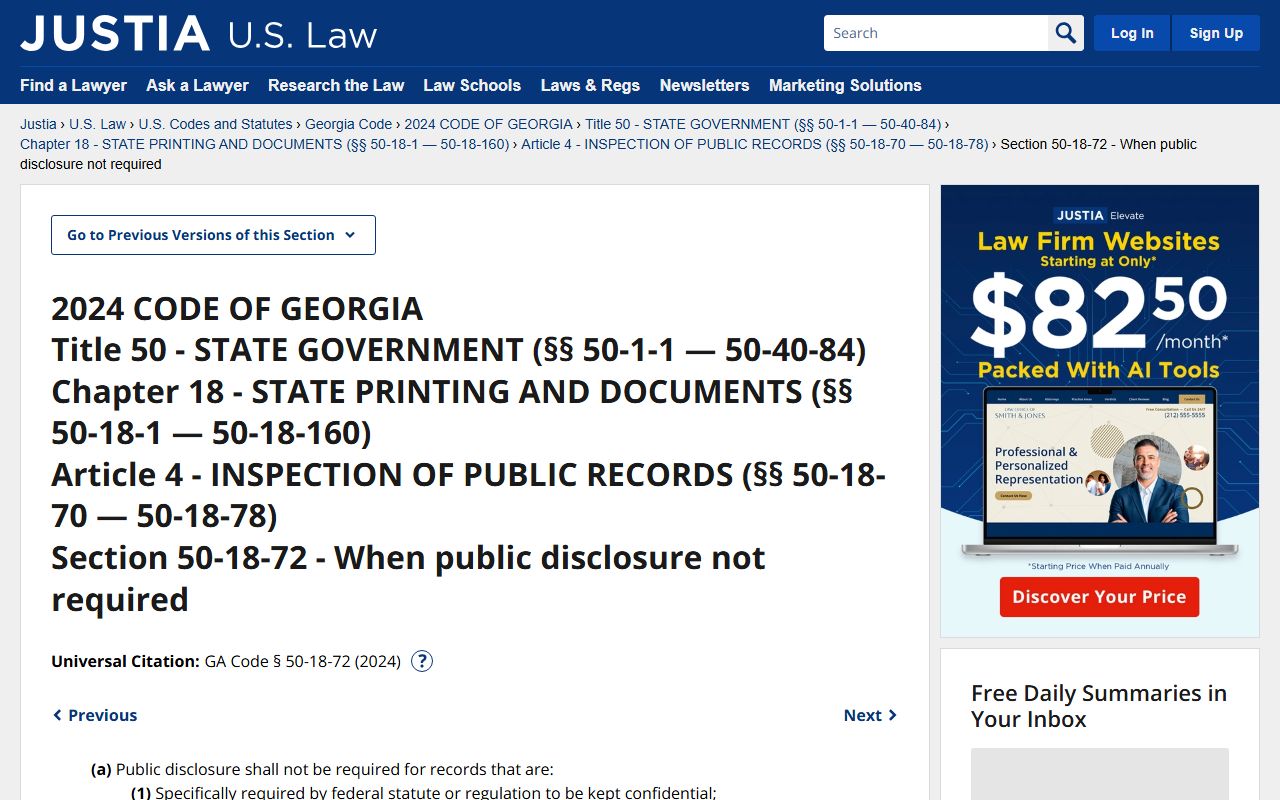
The page lists the categories of records that agencies are not required to disclose, from medical files to certain law-enforcement records.
What Counts as a Chatham County Public Record
O.C.G.A. 50-18-70 defines a public record broadly. The list includes documents, papers, letters, maps, books, tapes, photographs, computer-based or generated information, data, data fields, and similar material. The record has to be prepared, maintained, or received by an agency, or by a private person performing a service for an agency. A document created by a county worker on the county's behalf is a public record even if it sits on a personal device.
The Governor's Office page repeats one limit that catches many requesters. Agencies do not have to prepare a new report, summary, or compilation if no record exists. That rule comes from O.C.G.A. 50-18-71(j). A request for "all data showing X" can be denied if the agency does not already keep that view of the data. The fix is to ask for records the agency already has and let the agency sort the format.
Beyond court records, Chatham County agencies hold a wide range of public files. The Clerk of Superior Court alone handles several record categories that often surprise first-time requesters.
- Real estate records — deeds, mortgages, plats, UCC filings, and the Real Estate Division at the Clerk of Superior Court.
- Civil and domestic case files — divorces, name changes, civil suits, adoptions, child support.
- Criminal case files — Superior Court felonies and indictments through the Criminal Records Division.
- Notary and passport records — notary applications, passport acceptance services.
- Military discharge records — DD-214 filings under the Real Estate Division.
- Marriage records — held by Probate Court rather than Superior Clerk.
- Sheriff's records — arrest and booking logs, with HB 845 limits on booking photos.
How to File a Public Records Request
Georgia does not require a special form to make a request. A written email, letter, or fax is enough as long as it identifies the records sought. The Act allows oral requests, but a written request creates a record of the date and helps if a dispute comes up later. The steps below match the framework set out in the Open Records Act and the Governor's Office guidance.
- Identify the agency that holds the records you want. For court files, this is the clerk of the right court. For sheriff records, it is the Sheriff's Office. For real estate or business filings, it is the Clerk of Superior Court.
- Write a clear request. Name the records, the date range, and the format you want. A short, specific request gets a faster answer than a broad one.
- Send the request by email, fax, mail, or in person. The Clerk of Superior Court email is supctclk@chathamcounty.org and the phone is (912) 434-8920.
- Wait for the agency response. Under O.C.G.A. 50-18-71, the agency must respond within three business days. If records cannot be produced in that window, the agency must give a written timeline.
- Pay any approved copy, search, or redaction fee before records are released. Statutory limits apply under 50-18-71.
- If the request is denied or ignored, ask the agency to cite the exemption it is using. If the denial is wrong, the remedy is a civil action under O.C.G.A. 50-18-73.
Note: A request can be denied if it asks the agency to create a new report from scratch, because Georgia law has no duty to create records that do not already exist.
Chatham County Public Records Fees
Fees come from O.C.G.A. 50-18-71 and from court-specific fee statutes. The Superior Court Clerk fee schedule sits under O.C.G.A. § 15-6-77. The Clerk lists the most-used items on its civil intake page. Other clerks publish their own charts. The table below covers the items most often requested by the public.
| Item | Fee |
|---|---|
| Plain copy per page (Superior Clerk) | $0.50 |
| Oversized copy larger than 8.5 x 14 | $2.00 |
| State Court simple copy per page | $1.00 plus SASE |
| Probate uncertified copy | $1.00 per page |
| Probate certified copy, one page | $10.00 |
| Probate research fee (mailed / staff-assisted) | $10.00 |
| Sheriff's service of subpoena, plus copies | $50.00 + $0.50 per page |
| Issuing subpoena | $5.00 |
The Open Records Act allows reasonable fees for copying, search, retrieval, and redaction. Search and redaction time of up to fifteen minutes per request is free under the Act. Beyond that, the agency may bill at the salary rate of the lowest-paid employee qualified to do the work. The agency must give a fee estimate up front for larger requests.
Effective July 1, 2024, all civil filing fees with the Clerk of Superior Court rose $4 under SB 322. The same fee applies to adoptions, charters, petitions for review, trade name registrations, name changes, and other civil proceedings in Superior Court. Real estate filings use a flat $25 fee under HB 288.
What Is Exempt From Disclosure
O.C.G.A. 50-18-72 sets the exemption list. Disclosure is not required for several categories. Many of these protect personal privacy or a pending investigation. Knowing the common exemptions saves time on requests that would be denied anyway.
- Medical records and certain personal health information.
- Social security numbers, financial account numbers, and other personal identifiers.
- Certain pending law-enforcement and prosecution records.
- Trade secrets and confidential commercial information.
- Security records that would risk public safety.
- Juvenile records under O.C.G.A. 15-11-700 through 15-11-710.
- Sealed court records and adoption files.
Booking photographs are restricted under HB 845, which is why the Sheriff's Office does not publish mugshots on its booking lists. Criminal history is governed by O.C.G.A. § 35-3-37, which lets some arrest records be restricted from public view. The GBI record restriction page explains the process for arrests before and after July 1, 2013.
Response Timing and Enforcement
O.C.G.A. 50-18-71 sets the response clock. The agency must respond within three business days. If the records exist and are public, they must be produced. If they cannot be produced in three days, the agency must provide a written description of the records and a timeline for production. A complete denial requires the agency to cite the specific exemption in writing.
If a request is denied or ignored, the requester may file a civil action under O.C.G.A. § 50-18-73. The court can order production and may award attorney's fees and costs. Willful violations carry penalties under O.C.G.A. § 50-18-74. Court records denials may also need to be handled through court procedures rather than the standard executive-branch open-records workflow.
Key Chatham County Offices for Records
Different records sit with different offices. The list below pairs the record type with the office that keeps it. For court matters, the Clerk of Superior Court is the central record keeper for Superior Court. State, Magistrate, Probate, Juvenile, and Recorder's all have their own clerks.
Clerk of Superior Court
Tammie Mosley, Clerk
400 W. Oglethorpe Avenue, Suite 178
Savannah, GA 31401
(912) 434-8920
supctclk@chathamcounty.org
Probate Court
Judge Thomas C. Bordeaux, Jr.
133 Montgomery Street, Room 509
Savannah, GA 31401
(912) 652-7264
Sheriff's Office
Sheriff Richard S. Coleman
1050 Carl Griffin Drive
Savannah, GA 31405
(912) 652-7634
The Real Estate Division of the Clerk of Superior Court runs eRecording, FANS, military discharge records, and the real-estate fee schedule. The Civil Division handles adoptions, child support, and notary applications. The Criminal Records Division handles ordering court proceedings and Superior criminal forms. Each division has its own forms page on the clerk site.