
How to Search Chatham County Criminal Records
The Sheriff's site is the first stop for very recent arrests. The Chatham County Sheriff's Office publishes a 24-hour booking list and a 72-hour booking list. Each list shows DIN, name, birth date, race, sex, arrest date, arrest number, agency, bond amount, and charges. The lists are not a name-search jail roster. They are recent-booking lists that age out.
For court case files, jump to the re:Search Georgia portal that the courts link as Case Lookup. Felonies sit in Superior Court. Misdemeanors sit in State Court. Warrant applications and many preliminary criminal matters sit in Magistrate Court. Recorder's Court and city municipal courts hold local traffic and ordinance citations. For statewide criminal history, the request runs through the Georgia Crime Information Center and the Georgia Bureau of Investigation.
The Sheriff's bookings page carries the HB 845 notice and does not post booking photos. The Sheriff also disclaims warranties on accuracy, completeness, and reliability. Verify a status by phone if release or custody is the question. Receiving and Discharge / Booking answers 24/7 at (912) 651-3700; the Front Lobby is (912) 652-7785; the Shift Commander is (912) 652-7710.

That capture of the official 24-hour booking list shows the booking layout the site uses for recent arrests.
Chatham County Booking Record Fields
The Sheriff's booking list packs the case-level identifiers into a single row. The field set is consistent across the 24-hour and 72-hour lists. Anyone reading a booking entry can match the data to the case in court once an indictment or accusation is issued.
| Field | What It Shows |
|---|---|
| DIN | Detention identifier; examples P2605294, X0043454. |
| Name | LAST, FIRST MIDDLE format. |
| Birth Date | MM/DD/YYYY. |
| Race | Single-letter code such as B, W, H, N. |
| Sex | M or F. |
| Arrest Date | MM/DD/YYYY. |
| Arrest # | Numeric arrest number, example 2026050693. |
| Agency | Arresting or holding agency, such as Savannah PD, Chatham County SO, Pooler PD, or Chatham Co Superior Ct. |
| Bond | Dollar amount, examples $0.00, $2,400.00. |
| Charges | Statute or code, charge description, and F or M classification. |
The booking list does not show housing pod, mugshot, height, weight, court date, magistrate, warrant number, release date, or medical flags. A bond of $0.00 does not mean release is allowed; holds, probation, or state custody may still apply.
Types of Chatham County Criminal Records
Criminal records run from the first arrest entry to the final court disposition. Each step generates its own file. The court that handles the case depends on the charge level, and the records sit with that court's clerk.
- Arrest records — Sheriff bookings, agency arrest reports, and Magistrate warrant applications.
- Felony case records — indictments, motions, pleas, and sentences in Superior Court.
- Misdemeanor case records — accusations, motions, pleas, fines, and sentences in State Court.
- Traffic and ordinance records — Recorder's Court and city municipal courts; see traffic court records.
- Bench warrants and probation warrants — see warrant records for failure-to-appear and probation violations.
- State criminal history — the Georgia Crime Information Center file maintained by the GBI.
State Court says misdemeanors including traffic can be bound over from Bloomingdale, Garden City, Pooler, Port Wentworth, Savannah, Thunderbolt, and Tybee Island. Charges on the booking list often cite the Georgia code; examples include O.C.G.A. 16-5-21 aggravated assault as a felony, 40-5-121 driving with suspended license as a misdemeanor, and 42-8-38 probation violation in either class depending on the underlying case.
Charges vs Convictions in Chatham County Criminal Records
An arrest creates a record. A charge is a formal allegation. A conviction is a court finding of guilt. The three things look similar on a booking list, but the legal weight is very different. The Sheriff's booking entry is the start of the file. The court disposition is the end. Many cases end without a conviction.
| Stage | Charge | Conviction |
|---|---|---|
| Source | Arresting agency, Sheriff booking, charging document | Court order or judgment |
| Meaning | Formal allegation pending court review | Court finding of guilt or accepted plea |
| Where it appears | Booking list, accusation, indictment | Disposition line in the case file |
| Background check impact | May appear as an arrest record | Appears in criminal history record |
| Possible outcomes | Dismissed, nolle prosequi, plea, trial, acquittal | Sentence: fines, jail, probation, restitution |
Read the disposition line carefully. A charge filed is not a conviction. Cases can end in dismissal, nolle prosequi, plea, acquittal, or sentencing. The clerk's office is the official source if a docket entry looks off. The Chatham homepage disclaimer says the case management database reflects the file but the physical record controls.
Public Access Laws for Chatham County Criminal Records
Georgia treats most criminal court and agency records as presumptively public. The framework starts with the Georgia Open Records Act under O.C.G.A. Title 50, Chapter 18. Court rules and clerk fee statutes shape the rest. Initial arrest and incident data is generally available; investigative files, juvenile matters, and medical information are not.
Key Statutes:
O.C.G.A. § 50-18-70 — declares Georgia's strong policy in favor of open government.
O.C.G.A. § 50-18-72 — lists the exemptions including certain law-enforcement and investigative records.
O.C.G.A. § 35-3-37 — the criminal history record restriction statute that controls Georgia's expungement-style process.
O.C.G.A. 15-11-700 through 15-11-710 — juvenile hearing and record confidentiality rules.
O.C.G.A. § 50-18-73 — enforcement of the Open Records Act through civil action.
Booking photos are restricted under HB 845, which is why the Sheriff's Office does not publish mugshots on its booking pages. Media may still request booking photos for news collection through open records.
Sealed vs Expunged Chatham County Criminal Records
Georgia does not use the word "expungement" the way many other states do. Georgia uses "record restriction" under O.C.G.A. 35-3-37. The two concepts — sealing and restriction — address different parts of the record. Court records may need a separate court order to seal even after a state criminal history record is restricted.
| Aspect | Sealed Court Record | Restricted Criminal History (O.C.G.A. 35-3-37) |
|---|---|---|
| Scope | Court file in a specific case | State criminal history record at GCIC/GBI |
| Authority | Court order from the trial court | Prosecutor approval or arresting agency under statute |
| Public access | Public docket entry hidden | Not disclosed for non-criminal-justice purposes |
| Visible to law enforcement | Yes, by court rule | Yes, by statute |
| Common path | Motion to seal in the case court | Post-7/1/2013 arrests: prosecutor; pre-7/1/2013: arresting agency |
The GBI record restriction page spells out the application path. Restricted records are not destroyed for every purpose. Courts and criminal justice agencies still see them. Private background check sites may not update automatically after an official restriction.
Chatham County Agencies That Hold Criminal Records
Several offices keep parts of the criminal file. Knowing the right one saves a call. Sheriff Richard S. Coleman runs the Sheriff's Office and the Chatham County Detention Center at 1050 Carl Griffin Drive, Savannah, GA 31405. The District Attorney's Office at 133 Montgomery Street, Suite 600 prosecutes felonies and serves Victim Witness functions. State Court says misdemeanor accusations must be issued by the District Attorney within two years of the offense date.
The Circuit Public Defender represents people accused of felonies under Todd Martin at 222 West Oglethorpe Avenue, Room 130, phone (912) 447-4901. The Misdemeanor Defense Office at 133 Montgomery Street, Suite 505 handles misdemeanor appointment work at (912) 652-7443 with backup numbers at (912) 652-3097 and (912) 652-3091.
Sheriff's Office
1050 Carl Griffin Drive
Savannah, GA 31405
Booking (912) 651-3700
District Attorney
133 Montgomery Street, Suite 600
Savannah, GA 31401
(912) 652-7308
Public Defender
222 West Oglethorpe Avenue, Room 130
Savannah, GA 31401
(912) 447-4901
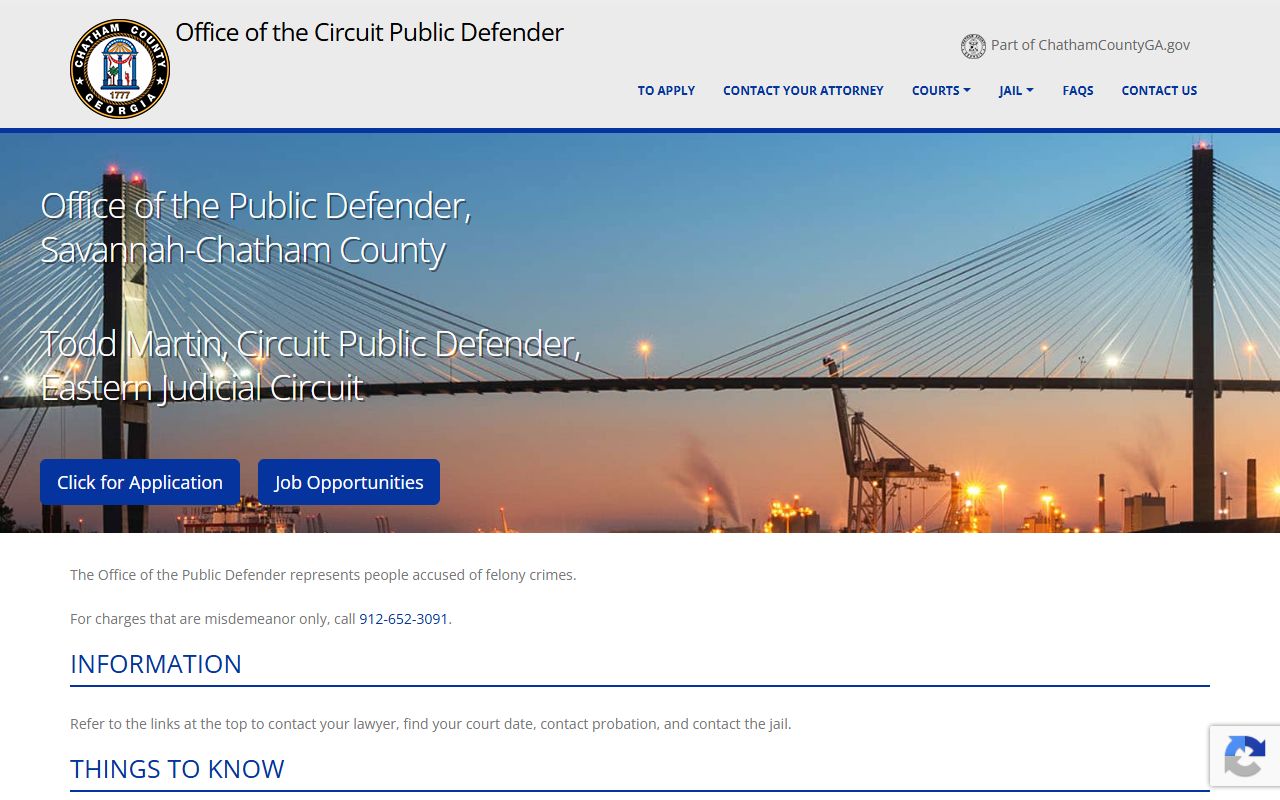
The Public Defender homepage from publicdefender.chathamcountyga.gov lists the felony representation scope and links to the application and hearing schedule.
Restricting a Chatham County Criminal Record
The Georgia record restriction path under O.C.G.A. 35-3-37 limits public disclosure of certain criminal history records for non-criminal-justice purposes when the statute's conditions are met. The GBI explains the application split: arrests after July 1, 2013 require contacting the prosecutor; arrests before that date require an application through the arresting agency.
- Identify the arresting agency and the prosecuting office on the case.
- Pull the case disposition from the court that handled it.
- For post-July 2013 arrests, request restriction from the prosecutor.
- For pre-July 2013 arrests, apply at the arresting agency.
- Verify the update with GCIC/GBI after approval.
- File a separate motion to seal the underlying court file when public docket entries still appear.
Common denial issues include convictions that are not eligible, missing disposition information, pending charges, incorrect agency routing, and statutory exclusions. A private background check site may keep an old record visible until its own data refresh.
Note: Record restriction is not the same as deletion; courts and criminal justice agencies still see the file under O.C.G.A. 35-3-37.