
Chatham County Magistrate Court at a Glance
Magistrate Court is a limited-jurisdiction trial court under O.C.G.A. 15-10-2. The Georgia Courts overview describes Magistrate Court as the office that issues warrants, hears minor criminal offenses, and decides civil claims of $15,000 or less. In Chatham, the court runs from the Frank S. Coleman Courthouse, Room 303, alongside Recorder's Court, Probate Court, the District Attorney, Victim Witness, the Law Library, and Indigent Defense.
The court has four judges: two full-time elected judges serving four-year terms and two part-time appointed magistrates named by the Chief Magistrate. Chief Magistrate Mary Kathryn Moss has served since January 4, 2005. The bench handles small claims trials, dispossessory hearings, garnishment summonses, FIFA filings, post-judgment interrogatories, and warrant application calendars throughout the week.
Magistrate Court of Chatham County
Frank S. Coleman Courthouse
133 Montgomery Street, Room 303
Savannah, GA 31401
Mon–Fri, 8 a.m.–5 p.m.
The Magistrate Court judges page lists the court composition and bench bios.
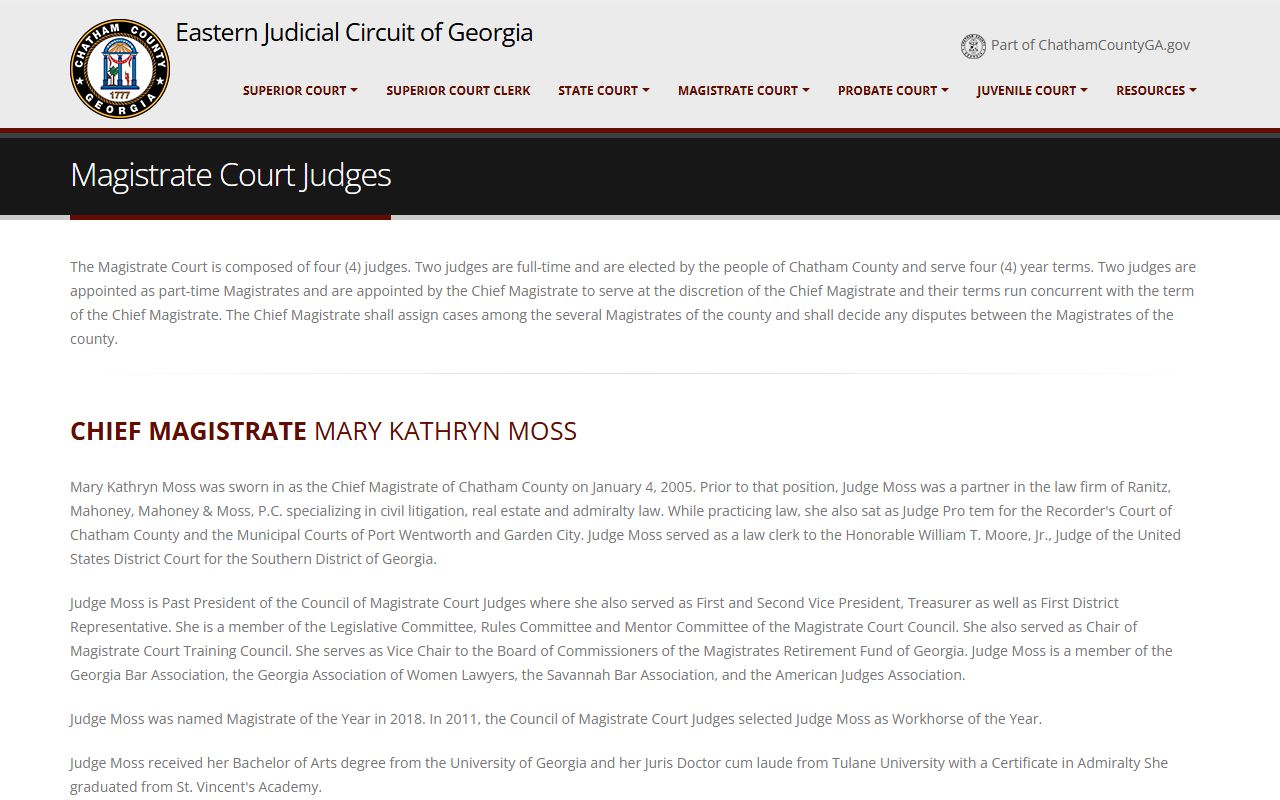
The judges page is the easiest way to confirm the Chief Magistrate and the elected/appointed mix on the bench.
What Chatham County Magistrate Court Handles
Magistrate Court's caseload is high volume and fast moving. The court does not hold jury trials. Many matters move from filing to hearing in weeks rather than months. The list below covers the major categories.
- Small civil claims — claims of $15,000 or less; statement of claim, answer, and bench trial.
- Dispossessory (eviction) — landlord-tenant possession, default writ requests, and writ of possession.
- Garnishment — wage and bank garnishments tied to existing judgments.
- Warrant applications — preliminary criminal warrants and good-faith applications.
- FIFA filings — writ of fieri facias for judgment enforcement.
- Post-judgment interrogatories — written debtor questions tied to a judgment.
- Abandoned vehicle, trover, and personal property foreclosure — covered by Georgia Magistrate law.
State Court hears appeals from some Magistrate rulings in Chatham, and Superior Court hears certain other reviews.
Chatham County Magistrate Court Service Rules
Service rules changed in 2024. The Magistrate forms page says that, effective August 1, 2024, service may be made by an authorized person under O.C.G.A. 15-10-43(b). Motions for private process server appointment will be rejected or referred to the standing order when the plaintiff complies with the statute.
Private process server arrangements and payment are handled directly by the requesting party. This is a clean break from the older practice of formally moving the court for appointment every time. Sheriff service is still available but no longer required for many filings.
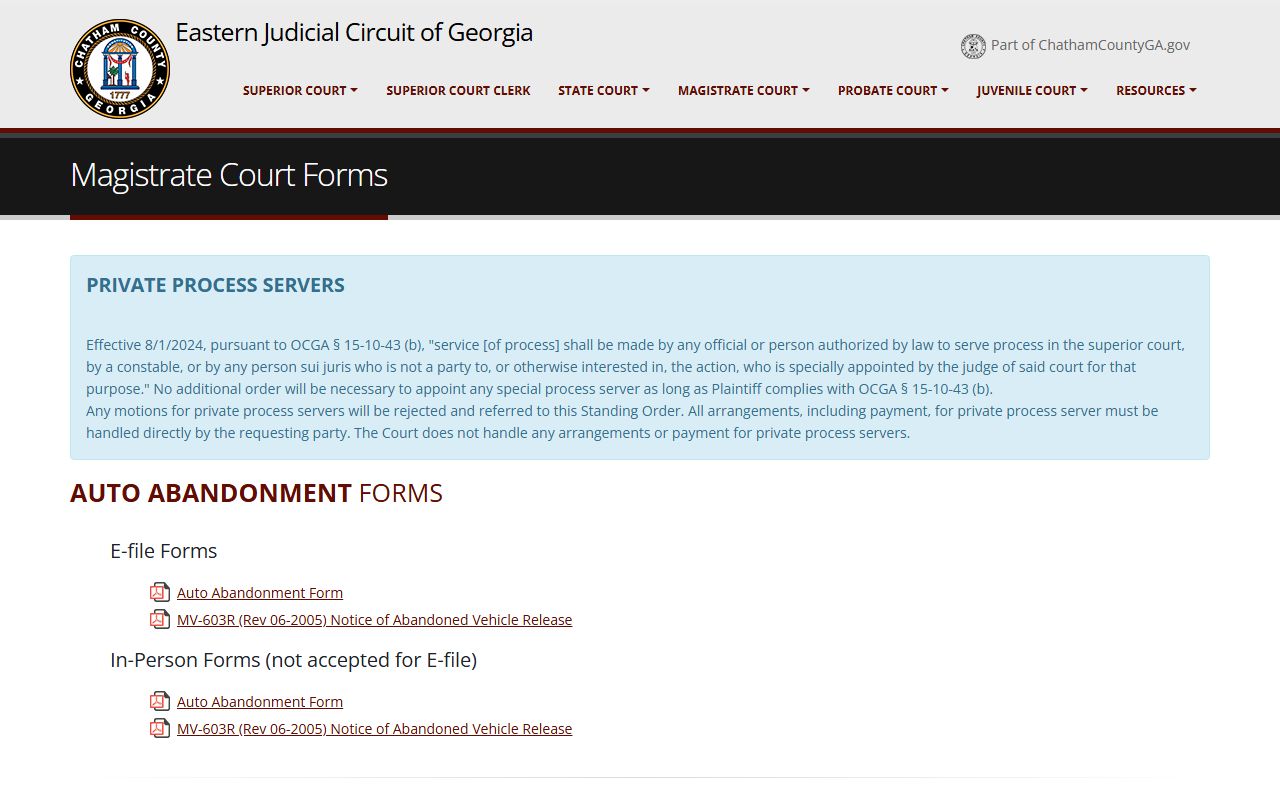
The Magistrate forms page is the canonical home for the standing order along with every standard civil filing template.
Chatham County Magistrate Court Fees
The Magistrate fee schedule covers civil suits, dispossessory, warrant applications, garnishment, FIFA, subpoenas, copies, certified copies, and exemplified copies. The Magistrate fee page is the official list. The summary table below captures the common items most filers see.
| Item | Amount |
|---|---|
| Civil suit filing | $20.00 |
| Dispossessory warrant filing | Per fee page |
| Warrant application | $20.00 |
| Garnishment | Per fee page |
| Writ of fieri facias (FIFA) | Per fee page |
| Subpoena | Per fee page |
| Copies per page | Per fee page |
| Certified copies | Per fee page |
| Exemplified copies | Per fee page |
Service fees are separate when sheriff service is used.
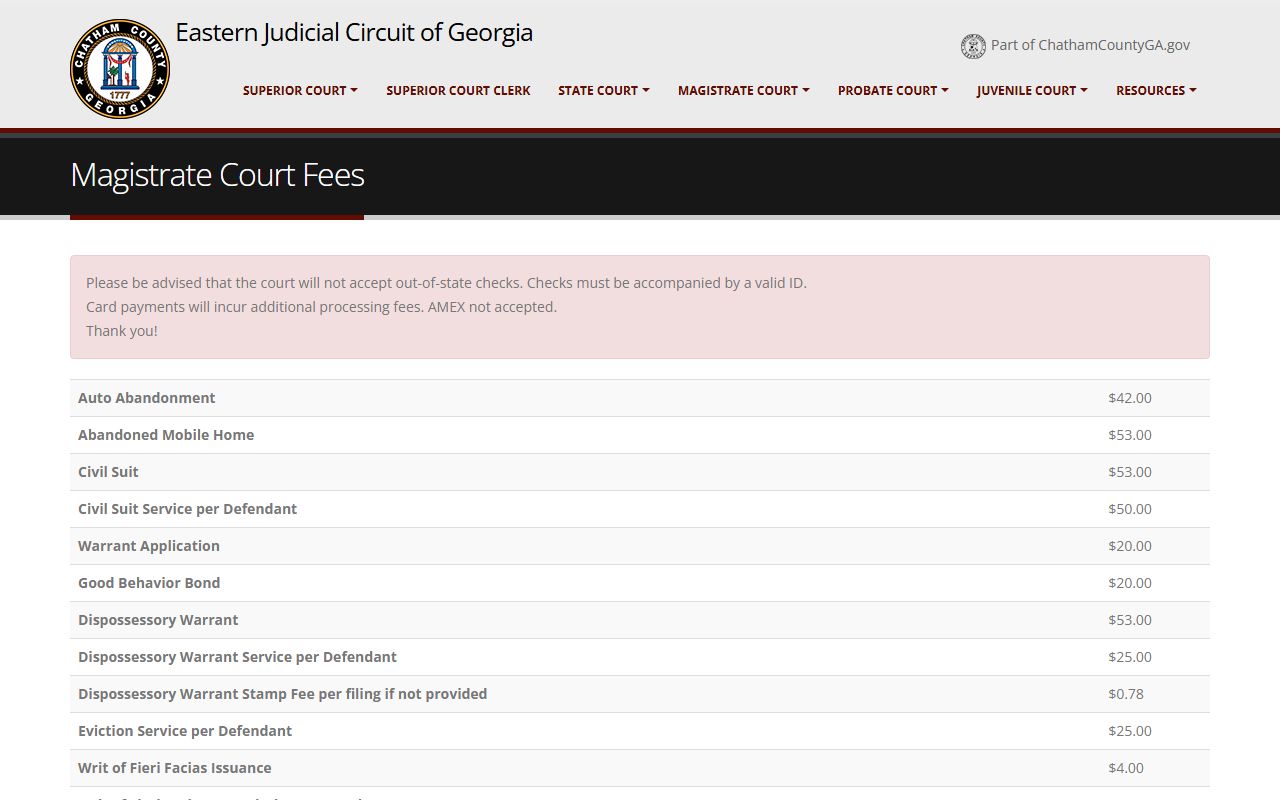
The fee page is the right starting point before any Magistrate filing is mailed or walked in.
How to File or Search a Chatham County Magistrate Case
Magistrate filings move through the court clerk in Coleman Room 303. The forms page hosts statement of claim, default writ request, eviction request, garnishment forms, FIFA, criminal forms, post-judgment interrogatories, and records request templates. The court accepts in-person filing and mailed filings.
- Pick the right form from the Magistrate forms page for the claim, dispossessory, garnishment, or warrant application.
- Complete the form with the case caption, party names, address for service, and amount in controversy.
- Submit the filing to the Magistrate Court Clerk in Coleman Room 303 along with the filing fee.
- Decide between sheriff service and authorized private service under O.C.G.A. 15-10-43(b).
- Track the answer window and watch the docket for the hearing date.
- For a search, use the Chatham Court System date proceedings and select the relevant tab to find calendar entries.
- For older records, ask the Magistrate Court Clerk for a records search.
Note: A warrant application is not the same as a criminal accusation, and the court will set a probable cause review before any warrant issues from the bench.
What a Chatham County Magistrate Court File Shows
A Magistrate Court file is built around a short list of standard documents. The civil side starts with a statement of claim and ends with a judgment or dismissal. The dispossessory side starts with the affidavit and ends with the writ of possession. The criminal side starts with a warrant application and ends with a probable cause ruling or a transfer to Superior or State Court. The list below captures the typical document set the public sees when reviewing a Magistrate case.
- Statement of claim — opens a civil case and lists the parties, amount sought, and basic facts.
- Answer — the defendant's response, due within the statutory window after service.
- Service return — proof of service by sheriff or authorized server.
- Dispossessory affidavit and answer — the eviction filing and tenant's response.
- Default writ request / writ of possession — enforcement documents tied to a dispossessory case.
- Garnishment summons and answer — sent to the garnishee, often an employer or bank.
- FIFA and post-judgment interrogatories — collection tools tied to a money judgment.
- Warrant application and probable cause ruling — preliminary criminal record.
Magistrate decisions can be appealed under specific statutes. Some appeals go to State Court in Chatham; others go to Superior Court. The Magistrate Clerk can confirm the correct path when an appeal is filed. Mailed filings should include payment by money order or cashier's check, and the court accepts in-person payment at the clerk window.
Common questions that come into the clerk's office include how much time runs between filing and a hearing, what the eviction timeline looks like after a writ of possession, and how a small claim moves from default to enforcement. The court does not give legal advice, so anyone facing a Magistrate matter should plan to consult counsel or use the self-help resources linked on the court site.