
How to Search Chatham County Court Records
The Chatham County Court System runs a public homepage at courts.chathamcountyga.gov with a date-based court proceedings search and direct links to case lookup, Probate Records, and Recorder's Court online payments. Pick a date, click View Cases By Date, and switch between Criminal, Civil, and Recorders tabs. For full case files and eFiled documents, use the re:Search Georgia portal that the courts link as Case Lookup.
Get the basics in hand before you start. A full legal name, a case number if you have one, and the court type help cut a long list down fast. Probate filings sit on a different portal at Georgia Probate Records. Recorder's Court traffic and ordinance payments run through the Municipal Online Payments portal.
- Open the Chatham County Court System homepage and use the Court Proceedings for date input for today's calendar.
- For case records, click the Case Lookup link to re:Search Georgia and search by case number or party name.
- Narrow results by court (Superior, State, Magistrate, Juvenile), case type, and date filed.
- Open a docket to read filings, orders, hearings, dispositions, and judge assignments.
- Request a certified copy through the Clerk of Superior Court eCertification service or the relevant clerk for non-Superior matters.
You can see what the homepage looks like in this view of the live Chatham County Court System landing page.
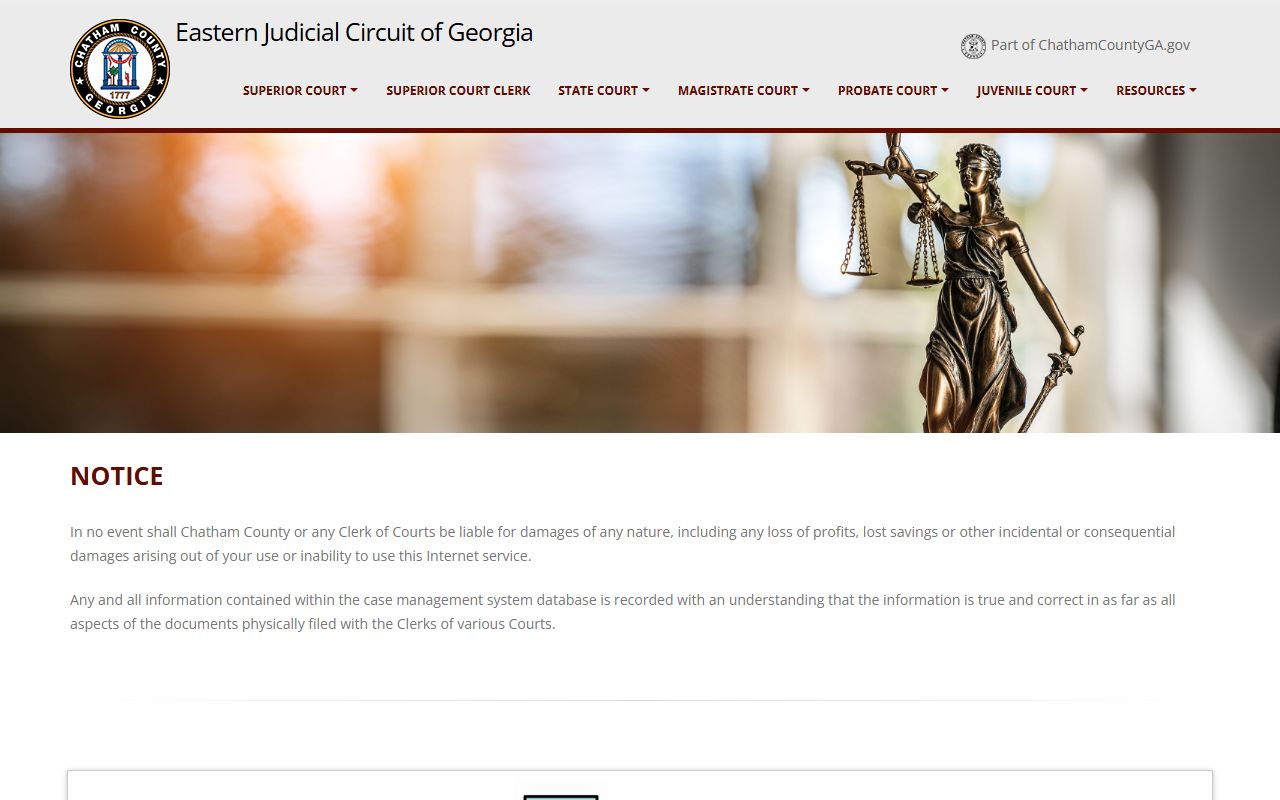
The same screen carries the official disclaimer that the case management database reflects documents filed with the clerks but is provided without warranty. Use the online tool to start, then verify in the clerk's office.
The Chatham County Judicial System
Georgia uses six classes of trial court instead of a single district court. Superior Court is the general-jurisdiction trial court. State Court handles misdemeanors and many traffic cases. Magistrate Court hears small civil claims, warrants, and dispossessories. Probate Court covers wills, estates, guardianships, and marriage licenses. Juvenile Court handles cases involving minors. Recorder's Court of Chatham County and city municipal courts handle local traffic and ordinance matters. The Judicial Council of Georgia explains the full court structure for the state.
Chatham County sits in the Eastern Judicial Circuit. Chief Superior Court Judge John E. Morse Jr. presides along with Judges Timothy R. Walmsley, Benjamin Karpf, Lisa Goldwire Colbert, Tammy Stokes, and Christopher K. Middleton. State Court has Chief Judge Gregory V. Sapp, Judge Elizabeth E. Coolidge, and Judge Derek J. White. Probate Judge Thomas C. Bordeaux, Jr. handles the Probate Court. Chief Magistrate Mary Kathryn Moss has served since January 4, 2005.
Case flow: Municipal / Recorder's Court › Magistrate Court › State Court › Superior Court › Court of Appeals of Georgia › Supreme Court of Georgia
| Court | Jurisdiction | Case Types |
|---|---|---|
| Superior Court | General trial | Felonies, divorce, equity, title to land, broad civil |
| State Court | Limited trial, county-wide | Misdemeanors, traffic, civil concurrent with Superior |
| Magistrate Court | Limited trial | Claims $15,000 or less, dispossessory, warrant applications, garnishment |
| Probate Court | Article 6, expanded | Wills, estates, guardianships, marriage licenses, weapons carry, mental health |
| Juvenile Court | Minors | Delinquency under 17, CHINS/dependency under 18 |
| Recorder's Court | Local | Chatham/Savannah traffic, ordinance, preliminary criminal matters |
Chatham County Courthouses
The Chatham County Courthouse Complex is two buildings side by side in downtown Savannah, plus a separate Juvenile Court. The official map and directions page lists the Frank S. Coleman Courthouse and the Eugene H. Gadsden Courthouse. A floor-by-floor view appears in the Courthouse Complex Directory.
Coleman Courthouse
133 Montgomery Street
Savannah, GA 31401
Probate (912) 652-7264
Eugene H. Gadsden Courthouse
400 W. Oglethorpe Avenue
Savannah, GA 31401
Superior Clerk (912) 434-8920
Juvenile Court
197 Carl Griffin Drive
Savannah, GA 31405
(912) 652-6700
Coleman houses Recorder's Court, Magistrate Court, Probate Court, the District Attorney, Victim Witness, the Law Library, and Indigent Defense. Gadsden houses the State Court Clerk, Superior Court Clerk, Jury Assembly, Jury Services, and the Superior and State Court courtrooms. The courthouse directory lists rooms by floor for both buildings.
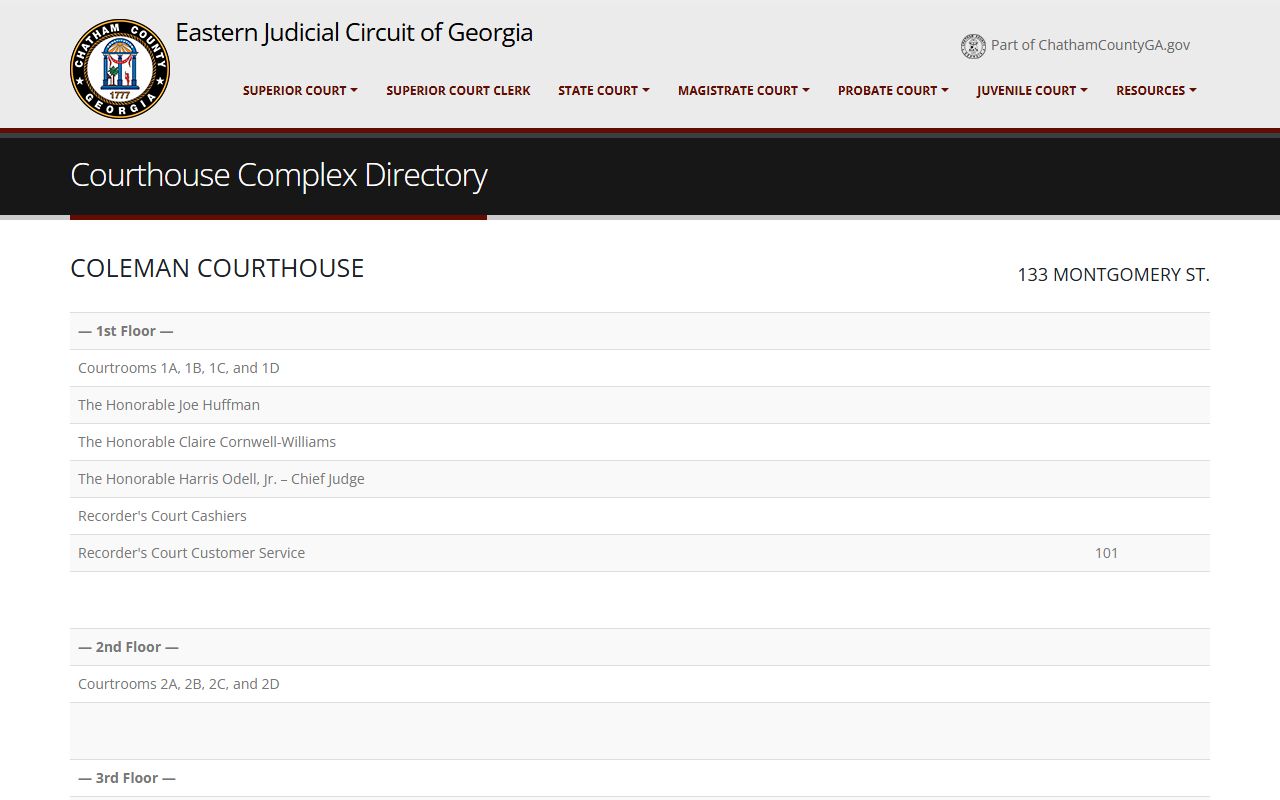
Use the directory to find a specific judge's chambers or the right clerk window before you arrive.
Types of Court Records Available in Chatham County
The court system produces criminal, civil, family, traffic, probate, juvenile, and small claims records. Each kind sits with the court that handled it. Superior Court holds felonies, divorces, and major civil matters. State Court holds misdemeanors and traffic. Magistrate holds small claims and dispossessory cases. Probate holds estates and marriage applications. Recorder's Court holds local Savannah traffic and ordinance citations.
The county clerks scan filed documents, so most records can be pulled online through the Clerk of Superior Court's portal or through re:Search Georgia. Older paper records may still need a clerk request.
- Criminal records — felonies in Superior Court; misdemeanors in State Court; warrant applications in Magistrate Court. See Chatham County arrest records.
- Civil records — general civil and domestic filings, garnishments, dispossessory warrants, foreclosure writs.
- Family / divorce records — divorces, custody, child support, and protective orders are Superior Court matters. See marriage and divorce records.
- Probate records — wills, estates, guardianships, conservatorships, and marriage licenses. See Probate Court records.
- Traffic records — Recorder's, municipal, and State Court hold the case file; DDS holds the driver record. See traffic court records.
- Juvenile records — access is limited under O.C.G.A. 15-11-700 through 15-11-710 and runs through the Juvenile Court.
What Chatham County Court Records Show
A Chatham County court record shows the case file as it sits in the clerk's office. The exact fields depend on the court, but the proceedings result list on the Chatham courts homepage is a good guide to what users see online.
| Field | What It Shows |
|---|---|
| Case Number | Court-assigned case ID; use this for the most precise lookup. |
| Filing Date | Date the case was opened with the clerk. |
| Parties | Plaintiff and defendant, petitioner and respondent, or decedent/estate. |
| Court / Courtroom | Court division and courtroom assignment. |
| Judge | Assigned judicial officer. |
| Attorney | Counsel of record where listed. |
| Type / Event | Proceeding or event type (motion, hearing, arraignment). |
| Disposition | Case outcome — dismissed, plea, conviction, judgment, closed. |
| Sentence / Judgment | Fines, jail, probation, monetary judgment, or court orders. |
The proceedings list adds Session, Time, StartTime, and CourtSessionID columns. Some financial fields and documents are visible only inside the case file on re:Search Georgia or by clerk request.
Public Access Laws for Chatham County Court Records
Georgia treats court and agency records as presumptively public. The framework starts with the Georgia Open Records Act under O.C.G.A. Title 50, Chapter 18. Court-specific access is also shaped by clerk fee statutes, juvenile confidentiality rules, and criminal history restrictions under O.C.G.A. Title 35.
Key Statutes:
O.C.G.A. § 50-18-70 — sets Georgia's strong policy favoring open government and defines what counts as a public record.
O.C.G.A. § 50-18-71 — lays out the inspection right, copy fees, search and redaction charges, and response timing.
O.C.G.A. § 50-18-72 — lists the exemptions: medical records, certain investigative files, personal identifiers, and other protected items.
O.C.G.A. § 15-6-77 — the Superior Court clerk fee statute that Chatham's local fee schedule follows.
O.C.G.A. § 35-3-37 — the criminal history record restriction statute that controls Georgia's expungement-style process.
Use the Chatham County public records page for a full walkthrough on how to file an open records request.
Records That Are Restricted or Confidential
Not every court file is open. Juvenile records are governed by O.C.G.A. 15-11-700 through 15-11-710 and are not treated like adult records. Sealed orders, adoption files, mental health filings, and protective order details often have limited access. Booking photographs are restricted under HB 845, which is why the Sheriff's Office does not publish mugshots on its booking lists.
Criminal history restriction under O.C.G.A. 35-3-37 is the Georgia version of expungement. The GBI's record restriction page says arrests after July 1, 2013 require contacting the prosecutor; older arrests go through the arresting agency. Restricted records remain available to courts and criminal justice agencies.
Specialty Courts in Chatham County
Chatham operates several accountability courts under the Georgia Accountability Court Program created in 2012. The lineup includes Drug Court, Mental Health Court, Competency Court, and Veteran's Court. These programs offer alternatives to standard sentencing for eligible nonviolent offenders with treatment, supervision, and judicial monitoring.
The Chatham State Court DUI Court is the most documented. Chief Judge H. Gregory Fowler started the program in May 2003. Eligibility includes two DUIs in five years or three DUIs in a lifetime. Treatment lasts at least one year and probation runs for two. Presiding Judge Derek J. White hears the cases and Charlene Middleton coordinates the program at (912) 652-3039. The court reports DUI Court graduate recidivism below 5% versus a national average above 19%.
Chatham County Sheriff and Jail
Sheriff Richard S. Coleman leads the Chatham County Sheriff's Office at 1050 Carl Griffin Drive, Savannah, GA 31405. The agency runs the Chatham County Detention Center on the same campus, opened in 1988 and expanded after 1989 because of inmate volume. Receiving and Discharge / Booking answers 24/7 at (912) 651-3700; the Front Lobby is (912) 652-7785; the Shift Commander is (912) 652-7710.
The Sheriff's site posts 24-hour and 72-hour booking lists with DIN, name, birth date, race, sex, arrest date, arrest number, agency, bond amount, and charges. For the full roster, the bond process, or visitation rules, see the Chatham County inmate records page. For active orders, see warrant records.
Marriage, Divorce, and Probate Records
Marriage licenses come from Probate Court in Coleman Courthouse Room 509. Divorce is exclusively a Superior Court matter in Georgia and runs through the Clerk of Superior Court. Estates, guardianships, and conservatorships sit with Probate. See marriage and divorce records and Probate Court records for the full process.
- Testator
- Person who made the will.
- Executor
- Personal representative named in a will to manage the estate.
- Administrator
- Personal representative appointed when there is no executor or no valid will.
- Guardian
- Person appointed to handle personal, health, and safety decisions for a ward.
- Conservator
- Person appointed to manage the property and finances of a ward.
Chatham County Court Records Fees
Fees vary by court. The Clerk of Superior Court civil intake page lists the most-used items; Probate publishes its own Probate Court fee page. All civil filing fees rose $4 effective July 1, 2024 under SB 322.
| Item | Amount |
|---|---|
| General civil and domestic filing (Superior) | $218.00 |
| Tenant dispossessory action (Superior) | $25.00 |
| Real estate filing (flat fee) | $25.00 |
| Plain copy per page | $0.50 |
| Probate research fee (mailed / staff-assisted) | $10.00 |
| Probate certified copy (first page) | $10.00 |
| Marriage license without premarital education | $76.00 |
| Marriage license with premarital education certificate | $36.00 |
| Family violence / stalking order filing | No fee |
Sheriff's bond service and Magistrate filings have separate fee schedules.
How to Interpret Chatham County Court Records
A docket reads like a timeline of filings and orders. Common abbreviations include CV for civil, CR for criminal, DR for domestic relations, and SCDR for small claims. Charge entries on Chatham booking lists use the Georgia statute code, a short description, and an F or M classification for felony or misdemeanor. A bond of $0.00 does not always mean release is possible because holds, probation, or state custody flags can still apply.
Read the disposition line carefully. A charge filed is not a conviction. Cases can end in dismissal, nolle prosequi, plea, acquittal, or sentencing. The Clerk's office is the official source if a docket entry looks off; the homepage disclaimer says the case management database reflects the file but the physical record controls.
Accuracy and Record Limitations
Online court data refreshes from clerk activity, so there can be a lag between a hearing and an updated docket entry. The Sheriff's booking pages cover only the past 24 or 72 hours and do not show release dates. For older bookings, call the jail. For a charge that needs to be confirmed, call the clerk that holds the case file. The Sheriff and the courts both publish disclaimers about completeness and reliability.
Note: Treat online court and jail data as a starting point and confirm critical details with the clerk of court or sheriff before relying on them for legal or background-check purposes.
History of Chatham County Courts
Chatham's State Court traces back to the Mayor's Court of Savannah, created by the Georgia Legislature on February 13, 1796. The official State Court History page by Hon. James W. Head calls Chatham's State Court the oldest small claims court in Georgia. Original jurisdiction covered suits up to $50, seamen's wage cases, and committal hearings. Today the court system runs a modern technology stack with eFile Georgia, re:Search, eCertification, Probate Records, and courtroom livestreams.
Frequently Asked Questions
How do I search Chatham County court records online?
Use the Chatham Court System homepage for the daily date proceedings and the Case Lookup / re:Search Georgia link for case files and eFiled documents. Probate matters use Georgia Probate Records. Recorder's Court traffic and ordinance citations use the Municipal Online Payments portal linked from the homepage.
Which court handles felony cases in Chatham County?
Superior Court, in the Eastern Judicial Circuit, handles felonies, divorces, equity, title to land, and broader civil matters. Chief Judge John E. Morse Jr. presides along with five other Superior Court judges. The Clerk of Superior Court maintains the records.
Where do I file for divorce?
Divorce is a Superior Court matter in Georgia. File with the Clerk of Superior Court at 400 W. Oglethorpe Avenue, Suite 178. The general civil and domestic filing fee is $218 plus applicable service fees. Family violence and stalking order filings carry no fee.
More on the Chatham County Court Records FAQ page.